The answer
How to Keep a Website Secure and Updated Without a Developer involves weekly monitoring, access reviews, backups, alerts, and urgent patches, followed by monthly scans, performance tests, and update reviews. Most websites need about one hour of focused maintenance each week, while safe updates require staging tests and a current backup before publishing.
Notes
- Most websites need about one hour of focused maintenance each week.
- Monthly maintenance can include a security scan, speed and mobile-responsiveness tests, and routine software-update reviews.
- Backups should be automated, stored off-site, and retained for at least days.
- Two-factor authentication adds a code needed to log in even if the password is stolen.
- Maintenance costs vary with a website’s size, complexity, and goals.
How to Keep a Website Secure and Updated Without a Developer: What routine security and maintenance tasks should a nontechnical website owner perform each week and month?
How to Keep a Website Secure and Updated Without a Developer starts with a short weekly check of uptime, performance, backups, security alerts, and urgent patches. Audit themes and plugins weekly, and replace software whose developers have stopped maintaining it. How to Keep a Website Secure and Updated Without a Developer also means reviewing administrator and editor access, removing accounts that are no longer needed, and changing shared-account passwords.
Each month, run a security scan, test speed and mobile responsiveness, and review routine software updates. Most websites need about one hour of focused maintenance each week. Use that time to check alerts first, then backups, access, software, and visible site performance. How to Keep a Website Secure and Updated Without a Developer is a repeatable maintenance routine, not a one-time security project.
Browse website maintenance on Fiverr
Key points
- Set aside about one focused hour each week for monitoring, backups, alerts, access, and urgent patches.
- Test CMS, theme, plugin, and extension updates in staging before applying them to the live site.
- Keep automated, off-site backups for at least days and test restoration in staging.
- Enable HTTPS, two-factor authentication, strong unique passwords, and a web application firewall.
- Use professional support when plugin or theme conflicts, technical updates, scans, or speed optimization exceed your confidence.
How can I update a website’s CMS, themes, and plugins safely without breaking the live site?
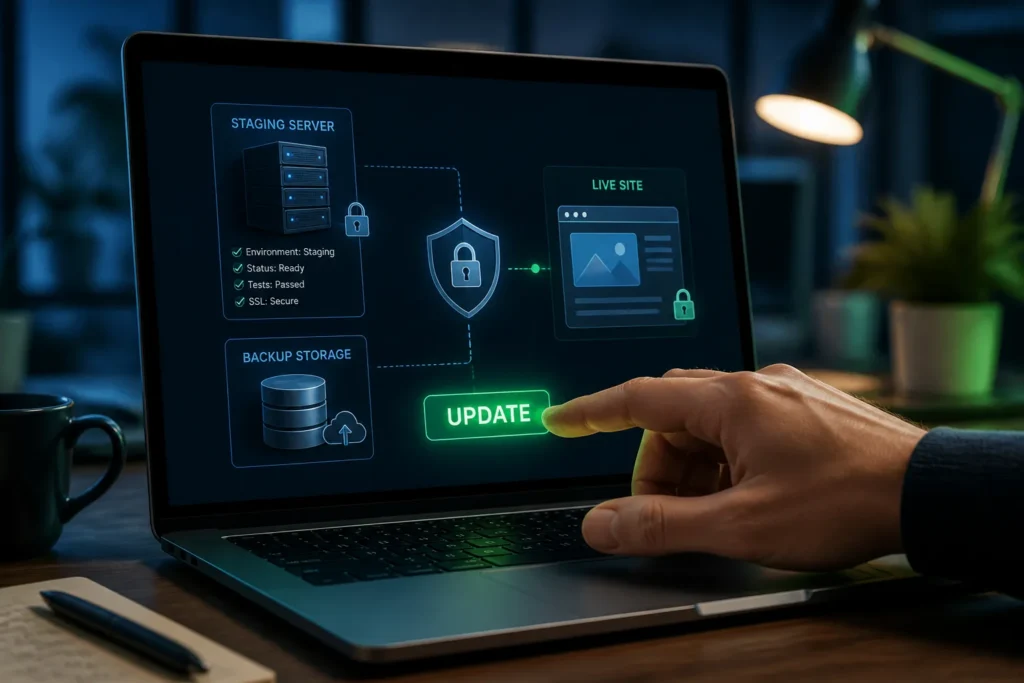
Safe website updating means scheduling, testing, and rolling out changes instead of applying them directly to the live site. How to Keep a Website Secure and Updated Without a Developer should therefore include a staging copy where you test the CMS core, theme, plugin, and extension compatibility. Apply updates to that staging copy and test site functionality before publishing the changes.
Make a current backup of the website before updating because a plugin or theme conflict may require a rollback. Apply CMS core security updates and patches almost immediately after release, while testing major updates in staging before they reach the live site. How to Keep a Website Secure and Updated Without a Developer is safest when “update” means test, confirm, back up, and then publish. If your platform uses maintenance mode, the ledger provides no specific setup instructions for it.
How to Keep a Website Secure and Updated Without a Developer can apply to a CMS such as WordPress, Drupal, or Joomla, but the ledger gives no platform-specific procedure for any of them.
Which website tasks are safe to automate, and which updates should be reviewed before installation?
Automation is best suited to repeatable checks, including security scans, uptime monitoring, and scheduled backups. For How to Keep a Website Secure and Updated Without a Developer, those automations provide coverage without removing your responsibility to review warnings.
Minor security updates may be allowed automatically, while major versions should be handled manually after testing. Review and test routine core, theme, and plugin updates before installation because plugins can create compatibility problems. How to Keep a Website Secure and Updated Without a Developer means separating urgent protection from changes that alter features or compatibility.
Apply security updates as soon as possible, but wait to test feature updates properly. Keep a record of failed updates, visible errors, and any rollback so the next decision is based on what happened rather than assumption. The ledger does not specify a particular automation product.
How often should I back up my website, and how can I test that I can restore it?
Website backups should cover both files and the database before updates. Backups are usually scheduled daily or weekly and should include files, databases, and content. For How to Keep a Website Secure and Updated Without a Developer, automate those backups, store them off-site, and retain at least days of backup history.
Keep three data copies on two storage types, with one copy off-site. Log into the backup system regularly to confirm that recent backups exist and are complete. How to Keep a Website Secure and Updated Without a Developer also requires a restoration test, not merely a successful backup notification.
Restore a recent backup in a staging environment and check that the site’s functions work. That test provides the practical check that files and databases can be restored without placing the live site at risk. The ledger doesn’t provide a recovery-time target or a detailed business-continuity plan.
How to Keep a Website Secure and Updated Without a Developer should treat restoration as a regular verification task, especially before a significant update.

What protections should I enable first, including HTTPS, multifactor authentication, and secure passwords?
HTTPS is the first protection to verify because Google marks websites without HTTPS as “Not Secure.” HTTPS uses an SSL certificate to protect website data, according to the cited guidance. For How to Keep a Website Secure and Updated Without a Developer, enable two-factor authentication so a stolen password alone isn’t enough to log in.
Use strong, unique passwords containing numbers, special characters, and uppercase letters. The ledger doesn’t provide guidance on password managers, so it doesn’t establish which manager to choose or how to configure one. How to Keep a Website Secure and Updated Without a Developer can also include a web application firewall that filters traffic in real time and blocks dangerous requests before they reach the website.
Verify quarterly that the SSL certificate remains valid and isn’t about to expire; an expired certificate triggers browser warnings. The ledger doesn’t identify Cloudflare or provide specific guidance for SQL injection or cross-site scripting.
How to Keep a Website Secure and Updated Without a Developer should begin with HTTPS, multifactor authentication, unique passwords, and certificate checks.
Get website maintenance pricing
HTTPS is only one protection layer, so regular malware scans are still recommended. Client-side malware scanners can check for hidden threats, malicious iframes, infected JavaScript files, and SEO spam injections. How to Keep a Website Secure and Updated Without a Developer should therefore include a scan routine rather than treating a valid certificate as a complete security check.
Where supported by security plugins, automate malware scans. Review unusual or suspicious activity regularly, and use login monitoring to identify suspicious access. How to Keep a Website Secure and Updated Without a Developer also means responding to warnings instead of ignoring them.
Review broader website security measures every six months. The ledger doesn’t provide a remediation sequence for a confirmed infection, nor does it name a specific scanner or monitoring service. How to Keep a Website Secure and Updated Without a Developer is therefore a monitoring approach: scan, review access activity, investigate anomalies, and reassess protections.
Watch
What do website backup, security monitoring, and maintenance tools typically cost, and when should I hire a professional?
Website maintenance costs vary with the site’s size, complexity, and goals. The ledger doesn’t provide a general price for backup, monitoring, or maintenance tools. One cited source says professional maintenance typically costs less than one hour of executive time. How to Keep a Website Secure and Updated Without a Developer should therefore be budgeted according to the work involved, not a universal rate.
You may handle routine content updates in-house while using professionals for security monitoring, software updates, backups, and technical troubleshooting. Plugin or theme update errors and conflicts are specific reasons to seek professional support. Many business owners review content themselves and hire professionals for technical updates, security scans, and speed optimization.
How to Keep a Website Secure and Updated Without a Developer is the practical focus of Shiro Web Studio, a resource for small businesses, online sellers, startups, entrepreneurs, and agencies evaluating website maintenance or development support. How to Keep a Website Secure and Updated Without a Developer can help you decide which routine work to retain and which technical work to outsource.
Ask any provider to clarify whether security monitoring, software updates, backups, and troubleshooting are included. The ledger doesn’t establish which provider handles those responsibilities by default. How to Keep a Website Secure and Updated Without a Developer remains a decision framework, not a quoted service package.

Find website maintenance experts
| Cadence | Maintenance time |
|---|---|
| each week | about one hour of focused maintenance |
| monthly maintenance tasks | 30–60 minutes |
| quarterly tasks | another hour or two |
Questions from clients
How to improve the security of a website?
Improve website security with HTTPS, two-factor authentication, strong unique passwords, regular software updates, backups, security scans, and access reviews. A web application firewall can also block dangerous requests before they reach the website.
How to not be vulnerable to fake websites?
The ledger doesn’t provide a method for identifying or avoiding fake websites. It does recommend HTTPS, strong unique passwords, and two-factor authentication for protecting website access.
Is an HTTPS page 100% secure?
No. HTTPS is one protection layer, and regular malware scans are also recommended. Client-side scanners can check for hidden threats, malicious iframes, infected JavaScript files, and SEO spam injections.
What are the five golden rules of a website?
The ledger doesn’t define five universal golden rules for websites. Its supported priorities are software updates, backups, access reviews, strong passwords, two-factor authentication, HTTPS, and malware monitoring.
